

Overview
- Outbound links are often misunderstood as either ranking boosters or ranking killers, when in reality their role in SEO is far more nuanced and strategic. This article explains what outbound links truly do and why they matter in modern search.
- While outbound links do not directly improve rankings, they influence SEO indirectly by strengthening content quality, trust signals, and user experience — all of which search engines increasingly prioritize.
- Google’s official stance, expert research, and real-world experiments show that linking out naturally and responsibly is a sign of a healthy, credible website, not a weakness.
- Poor outbound linking practices — such as linking to low-quality sites, paid links without disclosure, or outdated resources — can damage trust and create avoidable SEO risks.
- When used correctly, outbound links help SMBs build authority, support long-term visibility, and create content that earns trust from both users and search engines.
Why Outbound Links Still Create Confusion in SEO
Outbound links have been debated in SEO circles for over two decades, and yet they remain one of the most misunderstood elements of website optimization. Many business owners still operate under the assumption that linking to another website somehow weakens their own. Others have heard that linking to “high-authority” sites improves rankings and begin adding outbound links without considering relevance or value.
The reality is more balanced — and far more practical.
Search engines today do not reward or punish outbound links in isolation. Instead, they evaluate how and why those links exist within the context of content quality, user experience, and trust. Outbound links are not a shortcut to higher rankings, but they are a signal of credibility, transparency, and usefulness when used appropriately.
For SMBs, this distinction is critical. SEO is no longer about isolated tactics. It’s about building a website that behaves like a reliable resource, not a closed system. Understanding outbound links properly helps businesses avoid fear-based decisions and adopt strategies that support sustainable growth.
What Are Outbound Links?
Outbound links are links on your website that point to another domain. In simple terms, any time your content sends a visitor to a different website, that is an outbound link.
These links commonly appear when:
- Citing research or statistics
- Referencing official documentation
- Recommending tools or platforms
- Providing additional reading or clarification
Outbound links are different from internal links, which connect pages within your own website, and backlinks, which are links from other websites pointing to yours. While backlinks are widely recognized as a strong ranking factor, outbound links serve a different purpose — one that supports credibility rather than authority accumulation.
A well-structured website uses all three types of links naturally. Removing outbound links entirely often makes content feel incomplete or untrustworthy, especially for informational or educational pages.
Do Outbound Links Improve SEO?
The most honest answer is this: Outbound links do not directly improve search rankings, but they can support SEO in meaningful indirect ways.
Google has been clear that simply adding outbound links to well-known websites does not give your page a ranking boost. There is no “reward” for linking to Wikipedia, Google, or major media outlets purely for the sake of doing so.
However, outbound links influence SEO because they affect:
- How useful your content is to readers
- How trustworthy your information appears
- How search engines interpret your content’s context
SEO today is deeply connected to user satisfaction. Anything that improves clarity, trust, and experience can influence performance over time. Outbound links often play that supporting role.
Google’s Official Position on Outbound Links
Google’s guidance around outbound links consistently emphasizes one principle: links should exist for users, not for SEO manipulation.
Google representatives, including John Mueller, have repeatedly stated that:
- Linking out does not pass ranking benefits back to the linking page
- Normal outbound links do not cause ranking losses
- A complete lack of outbound links can look unnatural
Search engines expect legitimate websites to reference other resources. The web itself is built on interconnected information. A page that claims authority but refuses to acknowledge external sources may appear less credible than one that transparently cites them.
Google also advises that routine editorial links do not need to be marked as “nofollow.” Only specific cases — such as paid, sponsored, or untrusted links — require special attributes.
For reference, Google’s own documentation on outbound link handling can be found.
This is an example of a high-authority outbound link that genuinely adds value for readers seeking clarification.
The “Link Juice” Myth and Why It No Longer Applies
One of the most persistent SEO myths is the idea that outbound links “leak” ranking power. This belief originated from early interpretations of PageRank, where links passed value from one page to another.
In modern SEO, this fear is outdated.
Google has explicitly stated that linking out normally does not cause ranking loss. In fact, websites that aggressively block outbound links or mark every external link as nofollow can appear unnatural.
Search engines understand that quality content often references external information. The goal is not to hoard authority but to demonstrate relevance and reliability. Linking responsibly is a sign of confidence, not weakness.
How Outbound Links Indirectly Support SEO
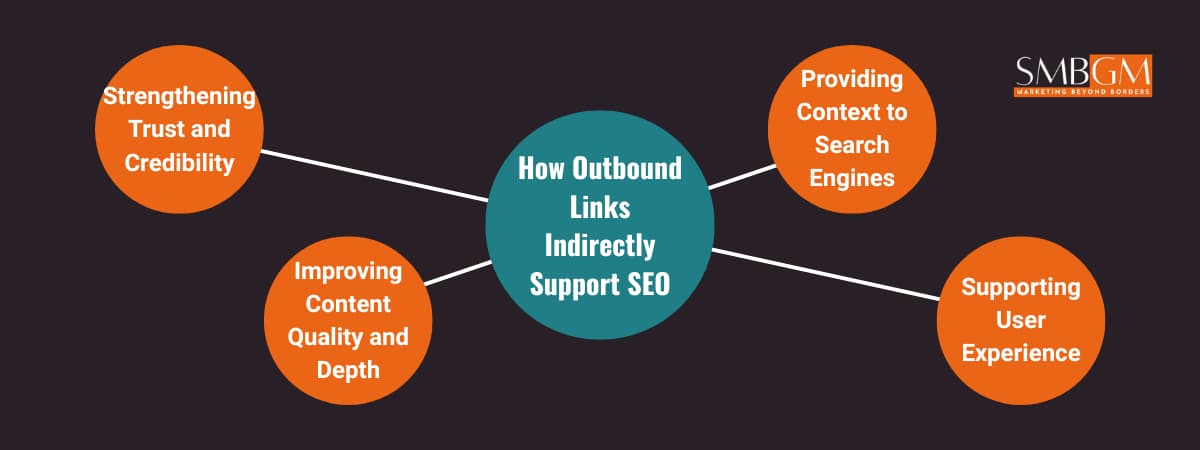
Improving Content Quality and Depth
High-quality content rarely stands alone. It builds on existing knowledge, research, and data. Outbound links allow content to acknowledge its sources, which improves depth and accuracy.
When users encounter content that feels researched and well-supported, they are more likely to:
- Trust the information
- Spend more time reading
- Return to the site later
These behavioral signals align with what search engines want to reward: content that genuinely helps users.
Strengthening Trust and Credibility
Trust is a central component of modern SEO, especially for topics involving business decisions, money, health, or professional advice. Outbound links help establish trust by showing transparency.
When a website backs up claims with reliable sources, it signals honesty. It allows readers to verify information rather than accept it blindly. Over time, this builds brand credibility — which matters far more than any single ranking signal.
Providing Context to Search Engines
Search engines use links to understand how content fits within broader topics. Outbound links act as contextual references, helping search engines interpret what your page is about and what it aligns with.
For example, a page about digital marketing that references reputable analytics studies or platform documentation provides clearer topical signals than one that makes unsupported assertions.
While content quality remains the primary factor, outbound links reinforce clarity.
Supporting User Experience
SEO and user experience are deeply connected. Outbound links enhance usability when they:
- Answer follow-up questions
- Offer deeper explanations
- Provide official or primary sources
A reader who feels guided rather than restricted is more likely to trust your site. That trust translates into long-term engagement, brand recall, and organic growth.
Research and Experiments: What the Data Suggests
SEO experiments have attempted to isolate the impact of outbound links. One of the most cited studies comes from Reboot Online, which conducted controlled tests comparing similar websites with and without outbound links.
Their findings suggested that pages with relevant outbound links performed better in search results than those without. While Google has not confirmed outbound links as a ranking factor, the consistency of these experiments points to a strong correlation.
The most reasonable interpretation is that outbound links improve performance by improving content quality — not by triggering a hidden algorithmic reward.
When Outbound Links Can Harm SEO
Outbound links are beneficial only when used responsibly. Poor linking practices can introduce real risks.
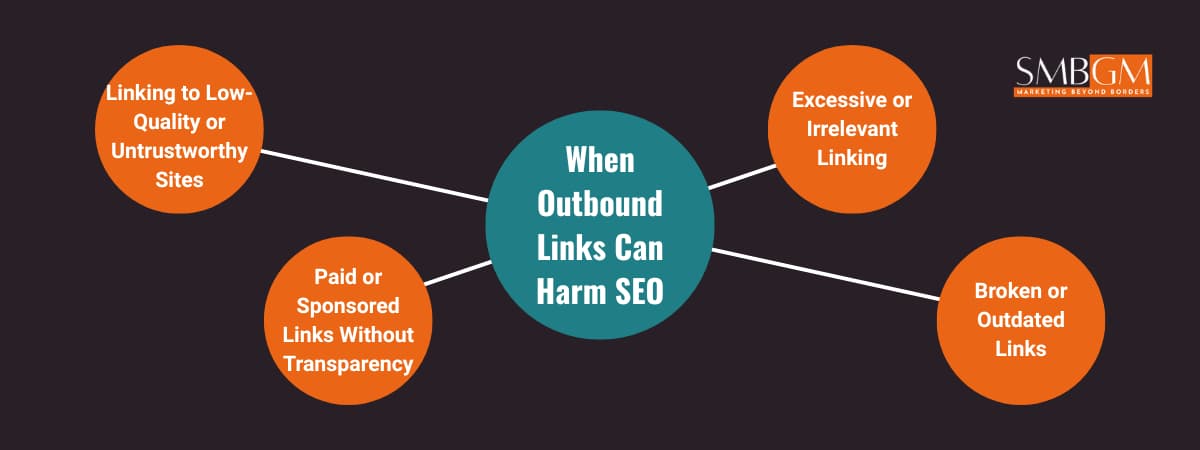
Linking to Low-Quality or Untrustworthy Sites
Every outbound link acts as a form of endorsement. Linking to spammy or misleading websites can harm your site’s perceived quality.
Search engines evaluate the “company you keep.” Repeatedly linking to questionable sources can weaken trust signals and, in extreme cases, invite manual review.
Paid or Sponsored Links Without Transparency
If a link exists because of payment, sponsorship, or affiliate arrangements, it must be disclosed appropriately. Failing to do so violates Google’s guidelines and can result in penalties related to unnatural outbound linking.
Transparency protects both users and search visibility.
Excessive or Irrelevant Linking
There is no ideal number of outbound links per page, but excessive linking can overwhelm readers and dilute focus. Links should support the narrative, not distract from it.
Relevance matters more than quantity.
Broken or Outdated Links
Outbound links require maintenance. Over time, pages disappear, domains change ownership, and content quality declines. Broken links create frustration and reflect poorly on site management.
Regular audits help ensure outbound links remain accurate and trustworthy.
How Outbound Links Affect the Sites You Link To
For the destination site, your outbound link becomes an inbound link — which can support their SEO authority if the link is editorial and trusted.
This is how the web ecosystem functions. Sites earn authority through references, not isolation. While you should never link out expecting something in return, participating in this ecosystem increases the likelihood of natural backlinks over time.
Best Practices for Outbound Links (SMB-Focused)
Outbound linking does not require complex strategies. It requires judgment.
Good practices include:
- Linking only when it adds clarity or value
- Choosing reputable, relevant sources
- Using clear, descriptive anchor text
- Allowing normal editorial links to remain followed
- Auditing links periodically
Outbound links should feel natural within the content, not forced or formulaic.
Outbound Links Are About Trust, Not Tactics
Outbound links are not an SEO hack. They won’t compensate for weak content, poor site structure, or lack of backlinks.
What they do support is credibility.
Modern SEO rewards websites that behave like responsible publishers — transparent, well-researched, and user-focused. Outbound links help demonstrate those qualities when used thoughtfully.
Final Takeaway for SMBs
Outbound links do not improve SEO because of algorithms.
They improve SEO because they improve content quality, trust, and user experience.
For SMBs building long-term visibility, the goal should never be to withhold value. It should be to create content that deserves attention, trust, and engagement.
Link out when it helps. Avoid it when it doesn’t. That balance is exactly what search engines — and users — expect.









 English
 Español