
Quick Answer: Do Nofollow Links Help With SEO?
The answer is yes, but primarily in indirect ways. While they do not pass direct ranking authority (link equity) like standard links, they are essential for a healthy, natural backlink profile. Modern search engines treat nofollow attributes as “hints” rather than absolute directives, meaning these links can still signal trust and relevance.
Key Takeaways:
- Driving referral traffic from high-volume sites like Wikipedia or major news outlets is often more valuable for sales than a simple ranking boost.
- Brand visibility and awareness increase significantly when you appear on major platforms, which signals authority to search engines.
- A natural link profile requires a mix of link types; having 100% “dofollow” links looks artificial and manipulated to Google.
- Faster content indexing occurs when bots find your pages through nofollow links on active news sites or forums.
Why Nofollow Links Still Spark Confusion
For many years, SEO advice around nofollow links was simple and dismissive: if a link is nofollow, it does not help SEO. This belief became so widespread that businesses actively avoided earning or pursuing nofollow links, assuming they were a waste of time and resources.
That mindset made sense when search engines treated nofollow links as absolute instructions to ignore a link completely. But search engines no longer operate that way. Their understanding of content, brands, and authority has become more nuanced, and so has the role links play within that system.
For small and mid-sized businesses, this confusion can be costly. SEO is rarely about one single factor delivering results on its own. It is about visibility, credibility, and consistency over time. Nofollow links contribute to all three when understood properly.
Rather than asking whether nofollow links help SEO in a narrow technical sense, businesses should ask a more practical question: do these links help people discover, trust, and engage with the brand? In many cases, the answer is yes.
What Is a Nofollow Link?
A nofollow link is a standard hyperlink that includes an attribute telling search engines that the linking site is not fully endorsing the destination page. This attribute was introduced in 2005 as a way to combat spam and manipulation, particularly in blog comments and user-generated areas of websites.
Before nofollow existed, spammers could easily place links on blogs and forums to artificially inflate rankings. The nofollow attribute gave site owners a way to link without passing authority or appearing to endorse untrusted destinations.
From a user’s perspective, there is no visible difference between a nofollow link and a regular link. Both are clickable and function the same way. The distinction exists only for search engines, which use the attribute as a signal when evaluating how links should influence rankings and crawling behavior.
Today, nofollow links appear in many legitimate contexts. Large platforms such as social media networks, forums, Wikipedia, and major news publishers use nofollow by default to protect themselves from spam and unintended endorsements. As a result, some of the most visible links on the web are nofollow.
How Search Engines Treat Nofollow Links Today
From Absolute Rules to Flexible Signals
When nofollow links were first introduced, search engines treated them as strict commands. A nofollow link was not crawled, not indexed, and not counted in ranking calculations. This made the rule easy to understand but limited how search engines interpreted real-world linking behavior.
Over time, this rigidity created blind spots. Search engines realized that ignoring large portions of the web’s link graph meant losing valuable information about how content and brands are connected. As a result, their approach evolved.
Today, major search engines treat nofollow links as hints rather than absolute rules. This means the link still communicates information, even if it does not automatically pass ranking authority. Search engines may use nofollow links to discover new pages, understand context, or analyze patterns of trust and relevance across the web.
This shift does not mean that every nofollow link suddenly boosts rankings. Instead, it reflects a broader move toward interpreting signals holistically rather than mechanically.
According to a 2026 industry survey of SEO professionals, 78.8% of experts believe nofollow links still impact rankings and overall search performance, reflecting growing recognition that these links contribute to visibility, brand authority, and user engagement even if they don’t pass direct ranking authority . This consensus among US and global SEO practitioners shows that nofollow links are widely seen as valuable components of modern backlink profiles and not merely technical footnotes.
Do Nofollow Links Pass Ranking Authority?
In most cases, nofollow links do not pass ranking authority in the traditional sense. If your primary goal is to increase domain authority metrics or improve rankings for competitive keywords, nofollow links alone will not deliver that outcome.
However, this does not mean nofollow links have no SEO value. Search engines can still observe where your site is mentioned, how often it appears in relevant contexts, and which trusted sources reference it. These observations contribute to a broader understanding of your brand and content.
For example, repeated mentions from respected publications can reinforce topical relevance and credibility, even if those links are nofollow. While these signals are indirect and harder to measure, they align with how modern search engines evaluate trust and authority at a higher level.
For SMBs, the key is to recognize that rankings are influenced by more than just direct link equity. Nofollow links support many of the supporting signals that make ranking growth possible over time.
How Nofollow Links Help SEO Indirectly
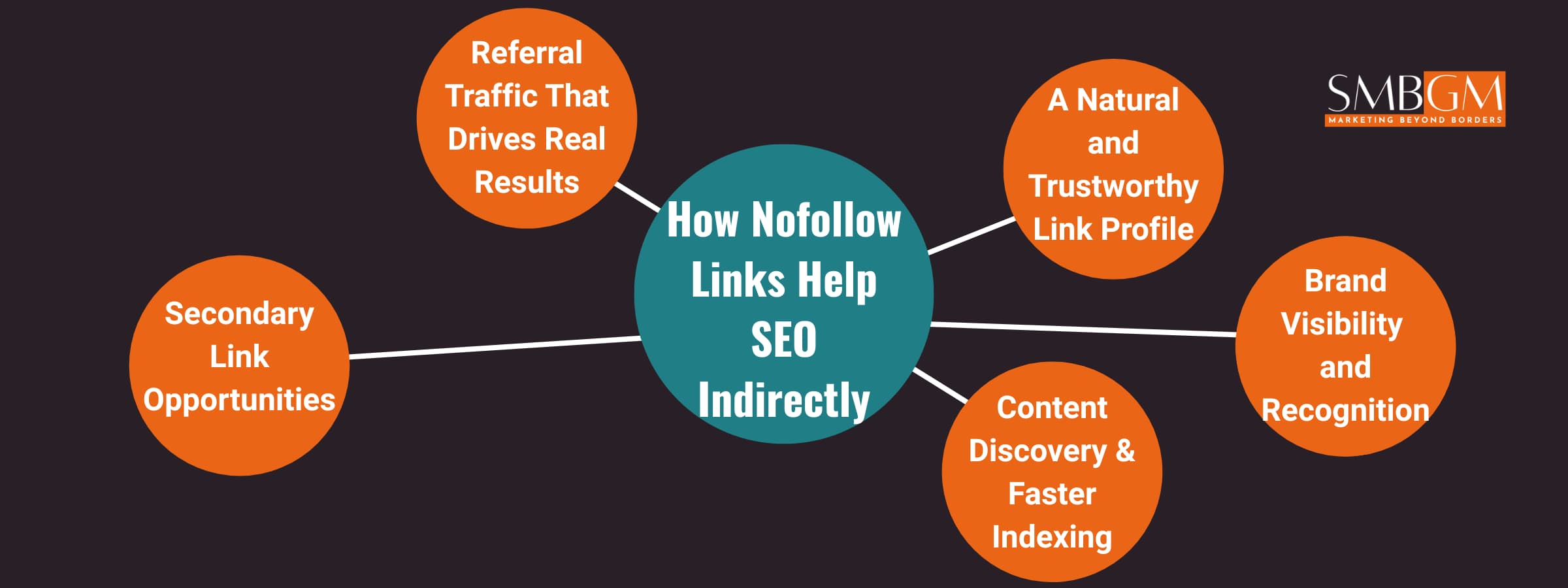
Brand Visibility and Recognition
One of the strongest benefits of nofollow links is increased visibility. Being mentioned on reputable, high-traffic websites exposes your brand to audiences that may never have encountered it otherwise. Even without ranking credit, this exposure creates familiarity.
Search engines increasingly reward brands that users recognize and actively search for. As more people see your name, read about your business, and remember it, branded searches tend to increase. This pattern signals legitimacy and relevance.
Over time, brand recognition supported by nofollow links contributes to stronger organic performance, even if the connection is indirect.
Referral Traffic That Drives Real Results
Nofollow links can generate meaningful referral traffic, especially when they appear in relevant discussions, reviews, or educational content. Visitors arriving through these links often have clear intent, making them more likely to engage, convert, or return.
For SMBs, this traffic can produce immediate business results such as leads or sales. In many cases, the commercial value of that traffic outweighs the theoretical SEO value of a followed link that sends no visitors.
SEO ultimately exists to support business growth, and referral traffic from nofollow links directly contributes to that goal.
Content Discovery and Faster Indexing
Search engines can use nofollow links to discover new pages and content. This is particularly important for new websites, newly launched products, or fresh content that has not yet earned many traditional backlinks.
Being discovered and indexed is a prerequisite for ranking. If a nofollow link helps search engines find your page faster, it accelerates that process and reduces reliance on other discovery methods.
For growing businesses, this can mean faster visibility and earlier traction for important pages.
A Natural and Trustworthy Link Profile
A backlink profile composed entirely of dofollow links looks unnatural. In real-world environments, websites naturally earn a mix of link types from a variety of sources.
Nofollow links signal organic attention rather than deliberate manipulation. They indicate that your brand is being talked about across platforms that do not pass authority by default.
This diversity helps support long-term SEO stability and reduces the risk associated with aggressive or artificial link-building tactics.
Secondary Link Opportunities
Nofollow links often serve as entry points rather than final outcomes. When your content or brand is discovered through a nofollow mention, it may later be referenced by other websites with traditional links.
Journalists, bloggers, and content creators frequently discover sources through nofollow-heavy platforms such as forums, news sites, or Wikipedia. These discoveries can lead to follow links elsewhere.
In this way, nofollow links act as catalysts that enable further growth rather than endpoints that deliver immediate ranking gains.
Understanding Nofollow, Sponsored, and UGC Links
Search engines recognize different link attributes to better understand the nature of a link. Nofollow is a general signal used when a site does not want to pass endorsement. Sponsored links identify paid relationships, while UGC links indicate content created by users rather than site owners.
From a ranking perspective, these links are treated similarly. The difference lies in transparency and intent rather than SEO advantage.
For SMBs, using these attributes correctly is less about improving rankings and more about maintaining trust with search engines. Proper labeling helps avoid penalties and demonstrates responsible linking practices.
How Nofollow Links Affect Different Types of Websites
Blogs and Content Publishers
Blogs often receive nofollow links from news outlets, aggregators, and social platforms. While these links may not boost rankings directly, they expand reach, attract new readers, and increase credibility.
For content-focused sites, being referenced is often more important than how the link is labeled. Visibility drives audience growth, which in turn supports long-term SEO success.
Ecommerce Websites
Ecommerce sites frequently earn nofollow links through influencer campaigns, product reviews, deal listings, and affiliate partnerships. These links may not pass authority, but they often drive high-intent traffic.
For ecommerce businesses, the ability of a link to generate sales or qualified leads is often more valuable than its impact on rankings alone. Over time, these mentions also support brand awareness and trust.
Forums and Community Platforms
Forum links are almost always nofollow, yet they play a significant role in niche credibility. Being mentioned in community discussions signals relevance and expertise to real users.
Authentic participation in these spaces builds long-term visibility and trust, even if the SEO impact is indirect.
Common Myths About Nofollow Links
Many businesses still believe that nofollow links are useless, that only dofollow links matter, or that nofollow links should be avoided entirely. These beliefs oversimplify SEO and ignore how search engines evaluate brands today.
In reality, nofollow links support many of the outcomes SEO is designed to achieve, including awareness, discovery, engagement, and credibility.
Best Practices for SMBs
SMBs should approach nofollow links as part of a balanced strategy rather than a binary decision. Focus on earning mentions from reputable, relevant websites regardless of link type, and measure success through traffic, engagement, and brand growth rather than rankings alone.
Paid and user-generated links should always be marked correctly, and quality should take priority over technical labels.
The Bigger Picture: SEO Is About Trust and Visibility
Modern SEO is less about exploiting individual signals and more about building a credible presence across the web. Nofollow links contribute to that presence by supporting awareness, trust, and content discovery.
When combined with strong content and a positive user experience, these links help create momentum that benefits SEO over time.
Real-World SMB Scenarios: How Nofollow Links Create Practical Value
Theory is fine, but how do nofollow links actually help a business grow? For most SMBs, growth doesn’t come from a single “dofollow” link, but from visibility and reputation.
Here is how nofollow links drive value in three common scenarios:
Professional Services: Building Credibility
Consider a professional services firm that gets mentioned in a major industry publication (usually a nofollow link). While they don’t get direct “link juice,” they gain immediate authority by association. Readers see the mention, search for the firm by name (Brand Search), and visit the site. These brand signals tell Google the business is legitimate and popular.
Ecommerce: Driving High-Intent Traffic
Another common scenario involves ecommerce businesses featured on a deal site or review platform. These links are almost always nofollow, but the traffic is “hot”—people are there to buy. Even if rankings don’t move an inch, the referral traffic generates revenue. For many businesses, sales matter more than metrics.
Local Business: Reinforcing Geographic Relevance
Local businesses frequently earn mentions on community event calendars or local news sites. These nofollow links reinforce the business’s location and community ties. When search engines see consistent mentions across local platforms, it strengthens “Local SEO” signals, helping the business show up in map packs.
In these cases, the nofollow link acts as a bridge, not a lever. It connects your business to real people and revenue, which eventually supports long-term SEO growth.
A Practical Decision Framework: Nofollow vs Dofollow Links
Rather than asking whether a link is nofollow or dofollow, SMBs benefit more from asking whether the link creates value. A rigid focus on link attributes can lead to missed opportunities that matter far more than rankings alone.
A dofollow link is most valuable when it comes from a relevant, trusted website and is placed naturally within content that aligns with your offerings. These links remain important for building authority and competitive rankings.
Nofollow links, on the other hand, excel in situations where visibility, credibility, or traffic are the primary outcomes. They are especially valuable when they appear on platforms that are widely trusted by users but restrictive with link endorsements.
A simple way to think about the decision is this: if a link would still be valuable even if search engines ignored it completely, it is worth pursuing. This mindset keeps SEO aligned with real business growth rather than technical checklists.
When Nofollow Still Wins
| Situation | Why Nofollow Links Are Valuable |
|---|---|
| Major news or media coverage | Builds authority, brand trust, and awareness |
| Influencer or review mentions | Drives high-intent traffic and sales |
| Forums and community discussions | Establishes credibility within niche audiences |
| Social media platforms | Expands reach and brand recognition |
| Wikipedia or reference sites | Signals legitimacy and topical relevance |
This table highlights a key principle: the value of a link depends on context, not just attributes. In many high-impact environments, nofollow is the norm, not the exception.
The Nofollow Impact Funnel
While nofollow links do not directly push rankings upward, they influence multiple stages of the customer and SEO journey. The following conceptual funnel illustrates how this impact unfolds over time:
Visibility → Engagement → Trust → Secondary Links → SEO Growth
At the top of the funnel, nofollow links increase visibility by placing your brand in front of new audiences. As users engage with your content, they begin to trust your brand. This trust leads to more searches, more mentions, and eventually more opportunities for traditional backlinks.
Search engines observe this entire process. While the initial link may not pass authority, the downstream effects contribute to stronger organic performance. This is why nofollow links are best understood as part of a system rather than isolated signals.
Frequently Asked Questions
Do nofollow links help SEO at all?
Nofollow links do not usually pass ranking authority, but they help SEO indirectly by improving visibility, driving traffic, supporting brand recognition, and contributing to a natural backlink profile.
Should SMBs try to convert nofollow links into dofollow links?
In most cases, no. Many platforms have strict editorial policies, and pushing for dofollow links can damage relationships. It is better to focus on the exposure and trust gained rather than the attribute itself.
Are nofollow links safe from penalties?
Yes. Nofollow links are designed to reduce risk, especially for paid or user-generated content. Using them correctly helps businesses stay aligned with search engine guidelines.
Can too many nofollow links hurt SEO?
Having a large number of nofollow links does not hurt SEO. However, relying exclusively on nofollow links may limit ranking potential. A healthy profile includes a mix of both.
Should internal links ever be nofollow?
No. Internal links should generally not use nofollow, as this can block search engines from properly understanding and distributing value across your site.
Final Thoughts
Do nofollow links help SEO? Not directly, and not in the way many people expect. But they play an essential role in how brands grow, earn trust, and become visible online.
For small and mid-sized businesses, nofollow links are not distractions or low-value opportunities. They are signals of relevance, credibility, and real-world engagement. When combined with quality content, strong user experience, and ethical SEO practices, they contribute meaningfully to long-term growth.
SEO opens the door. Visibility, trust, and consistency keep it open.








 English
 Español