For years, we’ve optimized websites to “rank” on Google. We chased keywords, backlinks, and blue links.
But the way people search has changed dramatically.
Today, users don’t always search — they ask.
They ask Siri, Alexa, Google Assistant, or ChatGPT:
“What’s the best preschool near me?”
“How do I renew my nonprofit status?”
“What are early signs of burnout?”
And instead of giving a list of web links, AI-powered engines now respond with answers.
This is the era of Answer Engine Optimization (AEO), the practice of structuring your content so that AI models, voice assistants, and search engines can pull your answer directly.
For small businesses, nonprofits, and educators, mastering AEO is no longer optional. It’s how your message, your expertise, reaches people who may never even click a link.
What Is Answer Engine Optimization (AEO)?
Answer Engine Optimization (AEO) is the process of crafting and structuring content so that search platforms, from Google’s AI Overviews to ChatGPT and voice assistants – can easily extract your information as a direct answer to user questions.
In other words, AEO helps your brand “be the answer,” not just appear in search results.
Traditional SEO focuses on keywords and rankings. AEO focuses on answers and visibility in AI-generated summaries, snippets, and voice responses.
Example:
- SEO Goal → Rank your product page for “best moisturizer for sensitive skin.” AEO Goal → Have your product or brand mentioned directly when someone asks Siri, “What skincare products are good for sensitive skin?”
Here’s what AEO looks like in practice:
- Writing in Q&A format
- Leading with short, factual answers (around 40–60 words)
- Using schema markup (structured data) so machines recognize your answers
- Keeping information clear, conversational, and current
As AI-driven platforms like Google Gemini, Bing Copilot, and ChatGPT dominate search behavior, AEO ensures your organization’s knowledge stays visible — even when users don’t click through.
Why AEO Matters in 2025
Search has quietly evolved into an answer-first experience.
Recent studies show that over 60% of Google searches end without a click — meaning users get the information they need right from the search results or AI summary.

Zero-Click Reality
When someone asks, “What’s the best software for small business invoicing?” or “What do I need to know before hiring a bilingual virtual assistant?” — the AI-generated answer may already include your competitors’ content. If your organization isn’t optimized for AEO, you simply vanish from that visibility layer.
AI and Voice Are the New Gatekeepers
- Over 400 million people use ChatGPT weekly.
- Voice assistants handle billions of queries daily.
- Google’s AI Overviews already appear in roughly 1 in 6 desktop searches.
This shift means that the next wave of discoverability isn’t about position one — it’s about being the trusted source behind the answer.
AEO for Small to Mid-Sized Businesses (SMBs)
AEO is a powerful way to stay visible in AI-driven search for SMBs. For example::
- An acupuncture clinic could be cited when someone asks Google Assistant, “What natural treatments help with chronic back pain?”
- A company selling online training programs might appear in ChatGPT’s answer to “What’s a good course for onboarding new remote employees?”
- A craft brewery exporting to Mexico could show up in Perplexity when users ask, “Where can I find American IPAs in Mexico City?”
AEO ensures your mission and expertise remain visible, even in the evolving world of AI-driven search.
Key Benefits of AEO
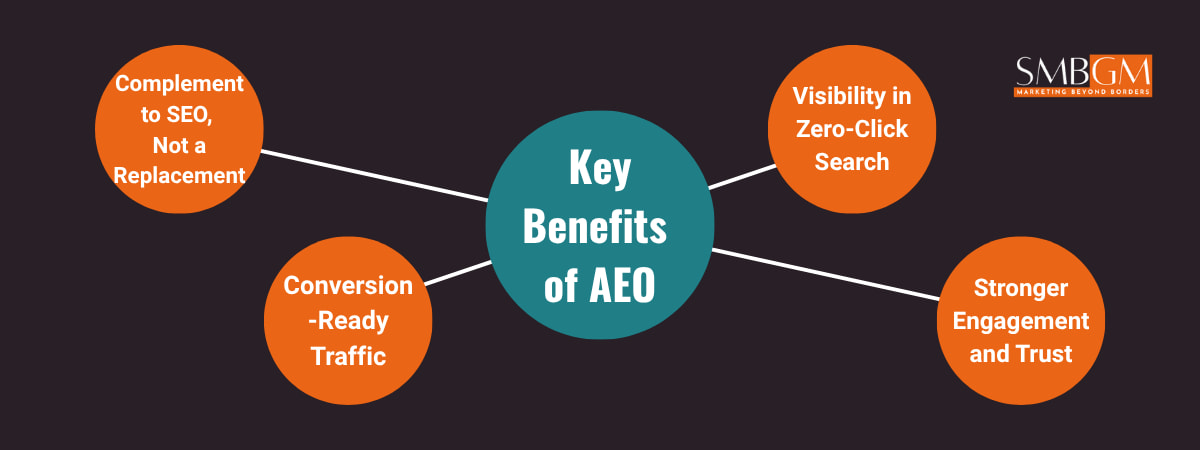
1. Visibility in Zero-Click Search
AEO lets your content appear in featured snippets, knowledge panels, and voice results — where most users now get answers.
If 60% of searches end without clicks, AEO ensures you still show up where users are looking.
2. Stronger Engagement and Trust
Users trust concise, authoritative answers. When your content provides that first, direct response, it positions your organization as credible and knowledgeable.
For example, a local therapy practice answering, “What is cognitive behavioral therapy?” in 50 clear words instantly builds authority before a client even visits their site.
3. Conversion-Ready Traffic
Visitors who arrive from AI and voice answers often have strong intent. They’re not browsing — they’re acting. Case studies show businesses see up to 20–30% higher conversion rates when they optimize content for AEO-driven queries.
4. Complement to SEO, Not a Replacement
AEO works alongside SEO.
When you optimize for both, you get dual benefits:
- AI visibility (for zero-click traffic)
- Search ranking (for traditional organic clicks)
This synergy strengthens your overall digital presence across both old and new search ecosystems.
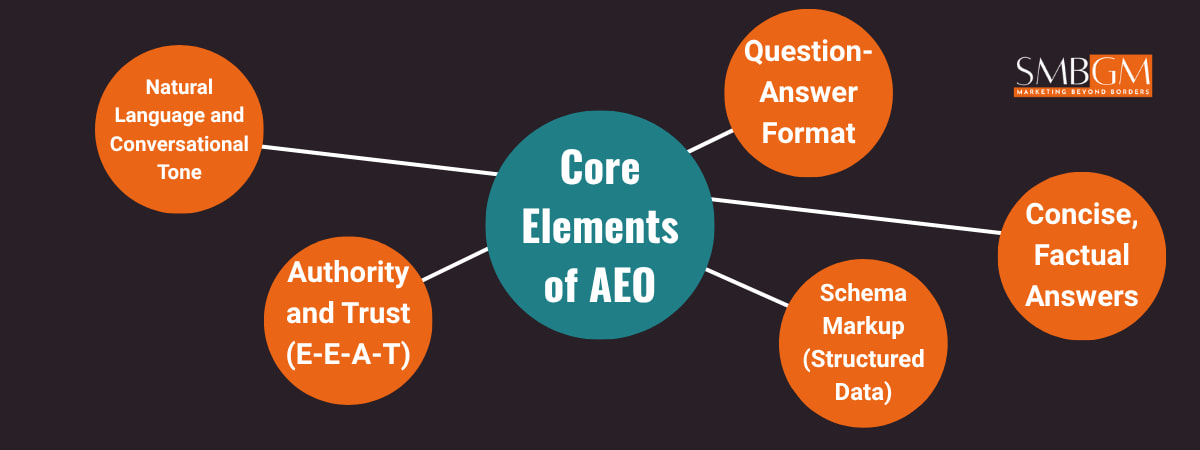
Core Elements of AEO
To succeed with AEO, your content must be structured for clarity, precision, and machine readability. Let’s break that down:
1. Question-Answer Format
Structure pages around specific user questions.
Use subheadings phrased as natural questions (e.g., “What is AEO?” or “How can nonprofits use AEO?”).
Then lead with a short, factual answer before expanding with details.
This mirrors how AI and voice systems understand language.
2. Concise, Factual Answers
Your first sentence should answer the question completely on its own.
Keep it to 40–60 words.
Think of it as writing the perfect summary — clear, objective, and self-contained.
3. Schema Markup (Structured Data)
This is how you tell search engines what’s what.
Using schema.org tags like FAQPage, HowTo, or Speakable helps AI and Google recognize your Q&A content and surface it as a trusted answer.
For example:
- A pest control service can tag its FAQ section with FAQPage schema.
- A vegan bakery can useSpeakable schema to provide voice-search-friendly answers like “Do you offer gluten-free options?”
4. Natural Language and Conversational Tone
People don’t speak in keywords; they ask in full sentences.
AEO content must reflect this — especially for voice and AI queries.
5. Authority and Trust (E-E-A-T)
AI systems prioritize reliable sources. Build trust through:
- Expert-written content
- Clear credentials (authors, citations)
- Reviews and external links
- Consistent updates to keep facts current
How AEO Differs from SEO
| Aspect | Traditional SEO | AEO (Answer Engine Optimization) |
|---|---|---|
| Goal | Rank high on search results pages | Be the cited answer in AI or voice search |
| Query Type | Short or long form keywords (“Best Indian restaurant near me”) | Conversational questions (“What’s the best Indian restaurant around here?”) |
| Content Format | Long-form, keyword-focused | Short, factual Q&A sections |
| Technical Focus | Crawlability, backlinks, meta tags | Structured data, schema, voice-readability |
| Measurement | Clicks, traffic, conversions | Featured snippet wins, voice impressions, AI citations |
| User Journey | Click → Read → Convert | Ask → Hear/See Answer → Remember or Act |
Both AEO and SEO share the same foundation — strong content, clarity, and trust.
But AEO expands your visibility into AI and voice ecosystems.
Best Practices for Implementing AEO
Step 1: Research the Questions Your Audience Asks
Use tools like:
- Google Search Console → Filter for “what,” “how,” or “why” queries
- AnswerThePublic or SEMrush Topic Research → Find long-tail, conversational questions
- ChatGPT or Perplexity → See what AI already answers (and identify gaps)
Build a list of 20–50 top questions relevant to your niche.
Step 2: Write Direct, Structured Answers
For each question:
- Use it as a subheading (H2 or H3).
- Write a concise, factual 40–60-word answer.
- Follow with optional context, examples, or visuals.
Example (for a therapist’s site):
Q: What is cognitive behavioral therapy (CBT)?
A: Cognitive behavioral therapy (CBT) is a type of talk therapy that helps individuals identify and change negative thought patterns and behaviors. It’s commonly used for anxiety, depression, and stress management.
Step 3: Use Schema Markup
Apply structured data like:
- FAQPage → For question-answer lists
- HowTo → For guides or step-by-step tutorials
- Speakable → For voice-readability
You can generate schema easily using tools like TechnicalSEO.com Schema Generator.
Step 4: Optimize for Featured Snippets
Google’s AI and snippets often pull from concise, well-structured paragraphs or tables.
- Keep each answer short and specific
- Use bullet points and comparison tables
- Highlight key terms and statistics
Step 5: Maintain SEO Best Practices
AEO builds on strong SEO foundations. Ensure:
- Fast page speed
- Mobile-friendly design
- Clear heading hierarchy (H1 → H2 → H3)
- Logical internal linking
- Quality backlinks and local citations
Step 6: Monitor and Iterate
Track:
- Featured snippet wins
- Voice assistant mentions
- AI tool citations (using tools like Profound or Daydream.ai)
- Zero-click impressions in Google Search Console
Refine answers based on data — small tweaks can make big visibility gains.
Tools That Help with AEO
- Google Search Console – Identify question-based queries with high impressions.
- Ahrefs / SEMrush – Track snippets and “People Also Ask” placements.
- Schema Generators – Easily create JSON-LD markup.
- AI Models (ChatGPT, Perplexity) – Test how your content appears in real AI answers.
- AI Visibility Platforms (Profound, Daydream.ai) – Measure citations across answer engines.
- CMS Plugins (Yoast, RankMath) – Add FAQ schema blocks without coding.
Real-World AEO Examples
- Healthcare Example – Therapy Practice
A small clinic created a “Common Questions” blog series with concise, structured answers about mental health topics.
They saw a 22% rise in new inquiries as voice assistants started citing their content.
- Local Business Example – Restaurant
A restaurant added a speakable schema to FAQs like “What are your vegan options?” Voice orders increased by 20% within three months.
These examples show that AEO works — not just for large enterprises, but for small, mission-driven organizations too.
Challenges and How to Overcome Them
| Challenge | How to Address It |
|---|---|
| Decline in page visits (zero-click) | Track brand visibility and engagement beyond clicks (e.g. voice mentions, leads) |
| Technical setup (schema, validation) | Use schema generators and plugins; test via Google Rich Results |
| Constant updates required | Refresh key answers every 2–3 months |
| Risk of oversimplification | Pair concise answers with detailed context below |
| Measuring ROI | Track assisted conversions, brand searches, and engagement metrics |
AEO success isn’t about traffic volume — it’s about visibility, trust, and action.
What’s Next for AEO (as of Fall 2025)
Answer Engine Optimization is no longer emerging, it’s maturing fast. Here are four key trends shaping its direction right now:
1. Personalized AI Answers Are Becoming the Norm
Search engines and AI assistants are tailoring answers based on user context, past behavior, and preferences. Your content must speak to different user intents — not just one-size-fits-all.
2. Multimodal Search Is Mainstream
Users now search with voice, images, and chat — often in combination. Your content needs to work across all formats: spoken, visual, and text.
3. Actionable Search Has Arrived
AI tools like ChatGPT and Google’s AI Overview can now help users book appointments, make reservations, or start sign-up flows directly from the answer. Your content must support those next steps.
4. Machine-Readable Content Matters More Than Ever
Clear structure, schema markup, and emerging metadata standards like /llms.txt are becoming essential. These help AI understand and prioritize your content.
As of late 2025, AEO isn’t about preparing for the future — it’s about keeping up with how people already search and act today.
How Can SMBs Get Started with AEO?
Here’s a quick roadmap for practical action:
- Audit your existing content.
Find FAQ sections, service pages, and blog posts that already answer questions. - Reformat for clarity.
Turn long paragraphs into structured Q&A blocks. - Add schema markup.
Use free tools or CMS plugins to make your content machine-readable. - Test your answers.
Ask ChatGPT, Google Assistant, or Perplexity your target questions — see if your content appears. - Iterate regularly.
Update data, rephrase answers, and test again every few months.
Over time, you’ll build a content ecosystem that search engines, AI, and users all understand instantly.
Conclusion
The way people find information is changing fast. Search today is no longer just about clicks and rankings; it’s about answers, conversations, and action. For small and mid-sized businesses, from local bakeries to SaaS course providers, visibility now means being part of the response — not just part of the results.
Answer Engine Optimization (AEO) is how you bridge that gap. It doesn’t mean starting from scratch. It means structuring your existing knowledge — your FAQs, blog posts, product pages, and service details, so AI tools can find it, understand it, and serve it where your audience is asking.
In this new landscape, the organizations that show up with clear, helpful answers are those that will lead.







 English
 Español